
Rykkinn School, Bærum
2019.06.04 10:32
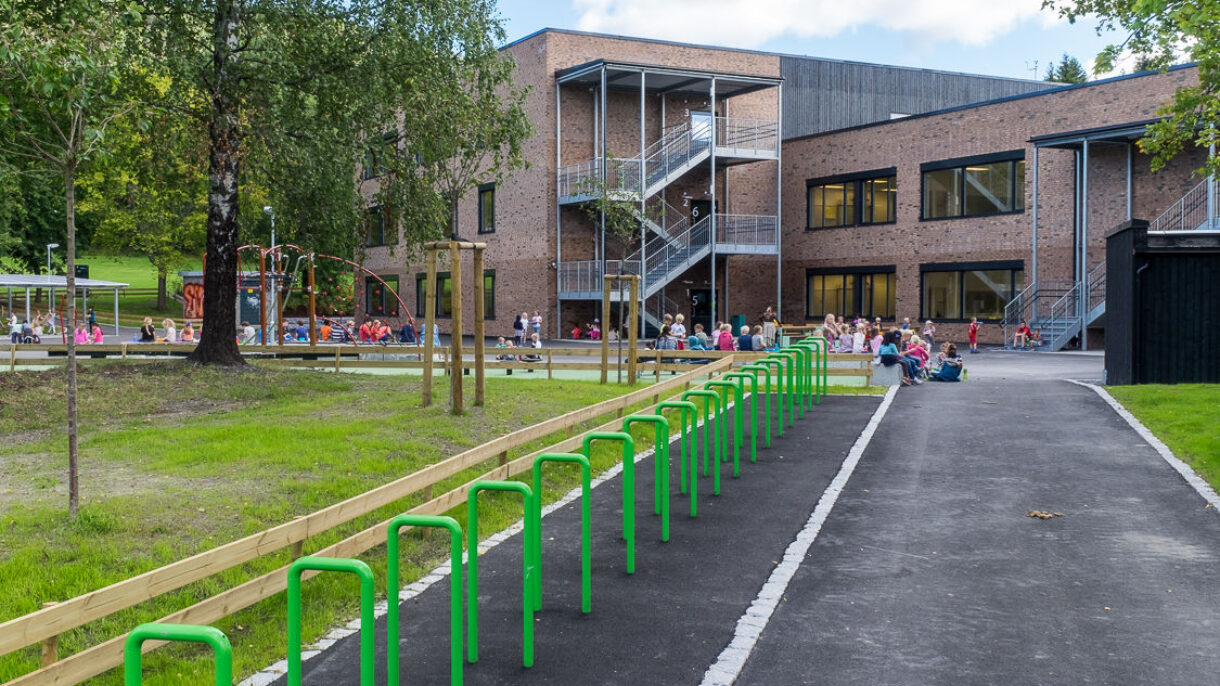
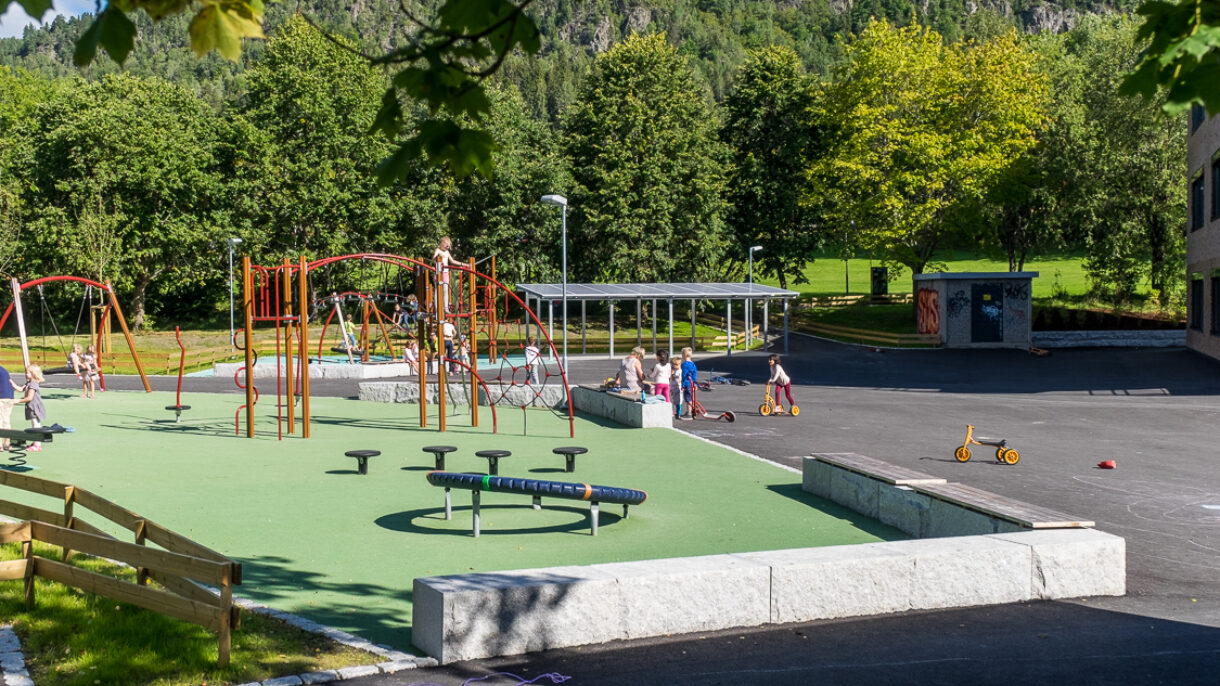
The passive house school Rykkinn has good daylight conditions in all rooms, and a variety of outdoor spaces facilitate outdoor teaching.
Developer
Skuleveg
Municipality
Bærum
Architect
Arkitektgruppen Lille Frøen
Landscape Architect
Bjørbekk & Lindheim
Interior Architect
Kapsel design
Status
Completed (2016)
Project description
Rykkinn school´s Berger division is a triple parallell primary school for the 1st to 7th grades with space for 650 pupils. In addition to the teaching spaces, the school contains a multi-purpose hall and an assembly room for large events.
The school building consists of four main wings that are connected to each other by a central backbone, which also includes special rooms for art and craft, music, assembly areas, science, reading and computer rooms, library, theatre and the school´s health service areas. Many of these rooms are also available after school hours.
The site for Rykkinn school is 16.800 m². The school is located in an established residential area and in the immediate vicinity of the Rykkinn pool and the Rykkinn athletic hall. The school building is pushed to the north to give the school optimal outdoor space to the south and west with good sun exposure.
The classrooms and the multi-purpose hall are placed in separate wings and have individual entrances. In the design process the focus was on simplicity and an intuitive spatial arrangement. Different zones for different school years will create a sense of safety and belonging in the pupils. The windows are placed so that all outdoor spaces can be seen from the building, in order to avoid bullying zones.
The school is designed to ensure a good learning and work environment. All the classroom areas are in direct contact with the outdoor space. In the evening the minimal lighting from the building will avoid unnecessary light pollution.
The design of the building emphasises good indoor air quality and extra attention was given to daylight, views and good acoustic conditions. All of the teaching areas and work spaces have a daylight factor of minimum 2.5%.
A variety of outdoor spaces facilitate outdoor teaching, various activities and recreation for the school and the local area. The building´s form naturally subdivides the outdoor area into different zones. Several play stations are spread around on the site so that the pupils can avoid having to congregate in one area.
Seating has been organised so that pupils can withdraw to more quiet, reflective spaces if desired. The amphitheatre in connection to the school´s main entrance will be a natural meeting point and functions both as an outdoor classroom and a tribune.
Good accessibility lies at the heart of the design. The outdoor space is divided into different zones that give the possibility of varied physical expression while accommodating children with different challenges. This contributes to the inclusion of everyone at Rykkinn school.
Low carbon strategies
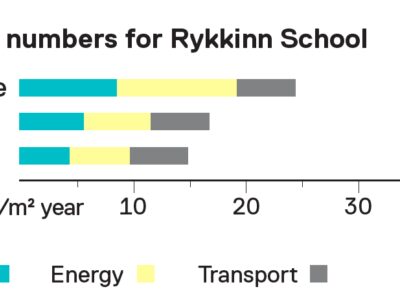
The greenhouse gas emissions for the ”as built” building show a reduction of 38% compared to the reference building, which was calculated using TEK 10.
The most important emission-reduction strategies for the project have been:
The selection of environmentally-friendly materials and a focus on products based on the largest CO2 reduction
Passive house standard
Optimisation of the building form with regards to material quantity, U-values and air-tightness
An environmentally-friendly and effective ammonia heat pump with a local energy well that will cover the needs of heating and hot water
Transport solutions that facilitate walking and cycling
The school is centrally placed in an established residential area with varied housing. Berger swimming hall and Rykkinn athletic hall are in the immediate vicinity. The area has a very well established walking and cycle path network. The location of the school means that pedestrians and cyclists will approach the school from many different angles, and cycle parking is spread out around the school to reflect this.
In the longer term a new tram stop is planned nearby Rykkinn school. The proposed locations ensure that there will be no need for new transport roads in connection with the Rykkinn tram stop. The school is planned with generous bicycle parking for both employees and pupils.
Rykkinn school is built as a passive house and satisfies energy class A. The energy supply for the building includes a heat pump connected to an energy well. Measured energy consumption has been an important theme, and a contract with a public-private partnership (OPS) supplier has been established. There has been extra focus on daylight conditions in all the teaching rooms. The school has modern lighting with effective control systems and daylight compensation. The lighting is placed asymmetrically in the spaces to ensure active use of daylight and to focus lighting on surfaces in line of sight.
The school has a water borne heating system based on low temperatures. The system supplies space heating, ventilation heating and hot water. The system´s primary heat source is a water to water heat pump with ammonia as the energy transfer medium, that collects heat from the local energy well. The school has a total of nine ventilation units tailored to the zoning of the building to ensure short conduit lengths and energy effective system management. Separate energy meters have been installed for space heating, hot water, lighting etc. that make it possible to accurately follow and adjust energy consumption through the BMS-system.
The project focused on achieving the best possible indoor air quality conditions so that the children and employees will have optimal conditions in the school buildings. An example of this is a water-based top coat used in the multi-purpose hall. This has a positive effect on the indoor air quality and satisfies the new, very strict EU/CEN requirements for maximum emission levels that will soon be in effect.
The project has emphasised structural solutions, storey heights and material choices that will make the building robust over time. Flexibility in terms of future modifications to the building and technical upgrades has been built into the design. Durable and robust materials had been selected for the interior and exterior surfaces. The structure of the building consists of steel and concrete. The reinforcement bars and structural steel have a high recycled content. Low-carbon concrete has been used in all delivered and poured concrete elements. A good deal of work went into optimising the structural components and the use of materials in the pre-project phase. Use of EPDs has been a natural part of the purchase process.
The project set a goal of sorting 80% of construction waste. In addition, there was a focus on the purchasing process in order to minimise materials amounts and thus waste generated on site.
Environmental Measures
Bymiljø og arkitektur
Tomten for Rykkinn skole er på 16.800 m². Den er plassert i et etablert boligområde og i umiddelbar nærhet til Rykkinn svømmehall og Rykkinnhallen. Skolebygget er trukket mot nord for å gi hjemmeområdene optimale utearealer mot syd og vest med gode solforhold.
Trinnområdene med undervisningsrom og flerbrukshallen er plassert i hver sin fløy og har separate inngangspartier. Det er lagt vekt på at skolen skal være lett å «lese». Man skal intuitivt forstå hvor man hører hjemme. De ulike sonene til de ulike klassetrinnene skal skape trygghet og tilhørighet for elevene. Vinduer er plassert slik at det vil være oversikt over alle uteområder fra bygget for å unngå mobbesoner.
Skolen er designet for å sikre et godt lærings- og arbeidsmiljø. Alle trinnområder ligger med direkte kontakt til utearealene. Minimal belysning fra bygget på kveldstid vil skjerme nærliggende boligområder for unødvendig lysforurensning.
Ved utformingen av bygget er det lagt særlig vekt på godt inneklima med ekstra fokus på dagslys, utsyn og gode akustiske forhold. Alle undervisningsarealer og arbeidsrom har en dagslysfaktor på minimum 2,5 prosent.
Varierte uteområder tilrettelegger for både uteundervisning, ulike aktiviteter og rekreasjon for skolen og nærmiljøet. Byggets form gir uteområdet en naturlig soneinndeling. Det finnes flere lekestasjoner som er spredt rundt på tomten slik at ikke alle elevene leker i samme område. Videre er det etablert sitteplasser og steder der man kan trekke seg tilbake. Amfiet i tilknytning til skolens atkomsttorg vil bli et naturlig samlingspunkt og fungere både som uteklasserom og "tribune".
Grunnlaget for god universell utforming ligger i hovedgrepet for bygget. Uteområdet er inndelt i ulike soner som gir mulighet for variert fysisk utfoldelse, og det er lagt vekt på tilpasning til barn med forskjellige forutsetninger. Dette bidrar til inkludering av alle på Rykkinn skole.
Klimagassutslipp
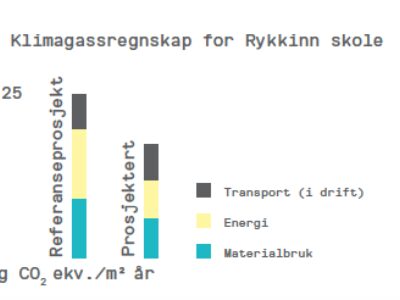
Klimagassutslippet for "som bygget" kan vise til 38 prosent lavere utslipp enn referansebygget, som er beregnet etter TEK10
De viktigste klimagasstiltakene for prosjektet har vært:
Valg av miljøvennlige materialer og fokus ved produktvalg på størst mulig CO2-reduksjon
Passivhus-standard
Optimalisering av bygningskropp med tanke på materialmengde, U-verdi og tetthet
Miljøvennlig og effektiv ammoniakk varmepumpe med lokale brønner som skal dekke behovet for oppvarming og tappevann
Transporttilpasninger som tilrettelegger for gange og syklingFullstendig klimagassrapport for Rykkinn skole ligger under Mer informasjon.

Areal og transport
Skolen er sentralt plassert i et etablert boligområde med variert boligbebyggelse. I umiddelbar nærhet ligger Berger svømmehall og Rykkinnhallen. Området har et svært godt utbygd gang- og sykkelvegnett. Plasseringen av skolen gjør at gående og syklende vil komme til skolen fra mange hold, og sykkelparkeringsplassene er plassert rundt på tomten for å imøtekomme alle.
På sikt vil det komme en holdeplass for T-banen i nærheten av Rykkinn skole. Endelig plassering er ikke besluttet, men mulige plasseringer er studert og plasseringen og formen på skolen sørger for at det ikke er behov for nye ferdselsveier til fremtidig holdeplass for Rykkinn.
Skolen er prosjektert med god dekning på sykkelparkering for ansatte og elever.
Fullstendig klimagassrapport for Rykkinn skole ligger under Mer informasjon.
Energi
Skolen er bygget som passivhus med ekstra fokus på gode dagslysforhold.
Skolen har en moderne belysning med effektiv styring og dagslyskompensasjon. Belysningen er plassert asymmetrisk i rommet for aktiv bruk av dagslys og fokus på belysning av flater i synsretningen.
Skolen har et vannbårent varmeanlegg basert på lavtemperatur og mengderegulert distribusjon. Anlegget betjener romoppvarming, ventilasjonsvarme og varmt tappevann. Anleggets grunnlastkilde er en væske/vann varmepumpe med ammoniakk som naturlig kjølemedium, som henter energi fra lokal brønnpark.
Skolen har totalt ni ventilasjonsaggregater tilpasset soneinndeling og utleiesituasjon for å oppnå korte føringsveier og energieffektiv styring.
Det er satt opp energimålere på alle energiposter som muliggjør god oppfølging av energiforbruket gjennom SD-anlegget.
Konstruksjoner og materialbruk
Det har vært vektlagt konstruksjonsprinsipper, etasjehøyder og materialbruk som gjør at bygget står seg godt over tid. Det er også fleksibelt med hensyn til fremtidige ombygginger og tekniske oppgraderinger.
Det har vært fokus på at interiør og eksteriør i den nye skolen skal være helhetlig og med slitesterke og robuste materialer.
Bærekonstruksjonen består av stål og betong. Armerings- og konstruksjonsstål har høy resirkuleringsgrad. Det benyttes også lavkarbonbetong i alle leverte og plasstøpte betongkonstruksjoner.
Gjennom forprosjektfasen av bygget er det jobbet mye med å slanke konstruksjonene og optimalisere materialbruken. Bruk av EPD er blitt en naturlig del av innkjøpsprosessen.
Det har vært et mål om 80 prosent kildesortering på bygget, men også fokus på mengder ved innkjøp slik at den totale avfallsmengden holdes nede.
Prosjektet har fokus på å oppnå et best mulig inneklima på Rykkinn skole. I den forbindelse, er det tilstrebet å velge de beste løsningene for at barna og personalet på Rykkinn skole skal ha optimale forhold når de oppholder seg på skolen.
Det er eksempelvis valgt en vannbasert toppcoating i flerbrukshallen som har en mer gunstig effekt på inneklimaet og tilfredsstiller de nye, svært strenge EU/CEN-kravene til maks emisjonsverdier som snart trer i kraft.
Key Figures
| Area BTA | 7911 m2 |
| Area BRA | 7400 m2 |
| Heated area BRA | 7400 m2 |
| Number of residents / users | 695 |
| Glass Share | 17,7 % |
| Compact clergy Factor | 0,2638 m3 volume/m2 |
GREENHOUSE GAS ACCOUNTING
| Reference | Project | Done | Operates | |
| Energy | 10,7 | 5,4 | 5,3 | — |
| material Use | 7,9 | 5,4 | 4,5 | — |
| Transportation | 5,2 | 5,2 | 5,2 | — |
ENERGY
| Energy label: | A |
| Heating Rank: | Light green |
| Supplied energy is calculated: | 50 kWh/m2/year (NS3031) |
| 35 kWh/m2/year Passive House standard |
ENERGY BUDGET
| Space heating: | 11,6 kWh/m2/year |
| Plumbing: | 6,9 kWh/m2/year |
| Hot water: | 10,1 kWh/m2/year |
| Fan operation: | 8,7 kWh/m2/year |
| Pump operation: | 4,3 kWh/m2/year |
| Lighting: | 9,8 kWh/m2/year |
| Technical equipment: | 13,3 kWh/m2/year |
| Ventilation Cooling: | 7,4 kWh/m2/year |
BUILDING TECHNICAL
| U-value roof: | 0,1 average value |
| U-value floor: | 0,1 average value |
| U-value exterior wall: | 0,12 average value |
| U-value window/doors: | 0,8 average value |
TRANSPORTATION
| Distance to center: | 1300 m |
| Nearest welding mac. koll.knutepkt: | 1300 m |
| Parking: | 0,11 (Pr. 1000 m2) |
| Bicycle Parking: | 4,4 (Per 1000 m2) |
Project Information
PROJECT DETAILS
| Address: | Leirdueveien 74, 1349 Rykkinn |
| Municipality: | Bærum |
| Project period: | 2014 - 2016 |
| Status: | Completed (2016) |
| Project type: | New building / addition |
| Function / Building type: | School / educational facility, sports facility / building |
| Environmental standard: | Passive house standard |
| Exemplar Program: | FutureBuilt |
| Competition Form: | Direct commission |
| Contract practice: | Public private partnership |
PROJECT TEAM
| Client: | Skuleveg AS |
| Architect: | Arkitektgruppen Lille Frøen AS | Bjørbekk & Lindheim AS | Kapsel design as |
| Environmental Consultant: | Ingunn Marton |
| Counselors: | Norconsult AS, Krøderen elektro As, Multiconsult AS, Norconsult AS, Brekke & Strand Akustikk AS |
| Main contractor: | Veidekke entreprenør AS |
| Subcontractors: | Unicon AS (lavkarbonbetong), Spenncon AS (lavkarbonbetong), Byggteknisk Stål AS (resirkulert stål), Norconsult AS (tekniske anlegg) |
Map
Map