Bjørnsletta School, Oslo
2020.11.25 16:07
This primary and secondary school has achieved passive house standard and scores highly on environmentally-friendly material use and transport. Optimising of the technical systems and detailed material analyses have been an important part of the project.
Developer
Undervisningsbygg Oslo KF
Municipality
Oslo
Architect
L2 Arkitekter
Environmental Consultant
Undervisningsbygg Oslo
Landscape Architect
Østengen og Bergo Landskapsarkitekter
Status
Completed (2014)
Project description
Bjørnsletta school was originally built as a middle school for about 200 pupils in 1981. In 2014 this school was demolished and replaced with a 10 100 square metres new building for 792 pupils.
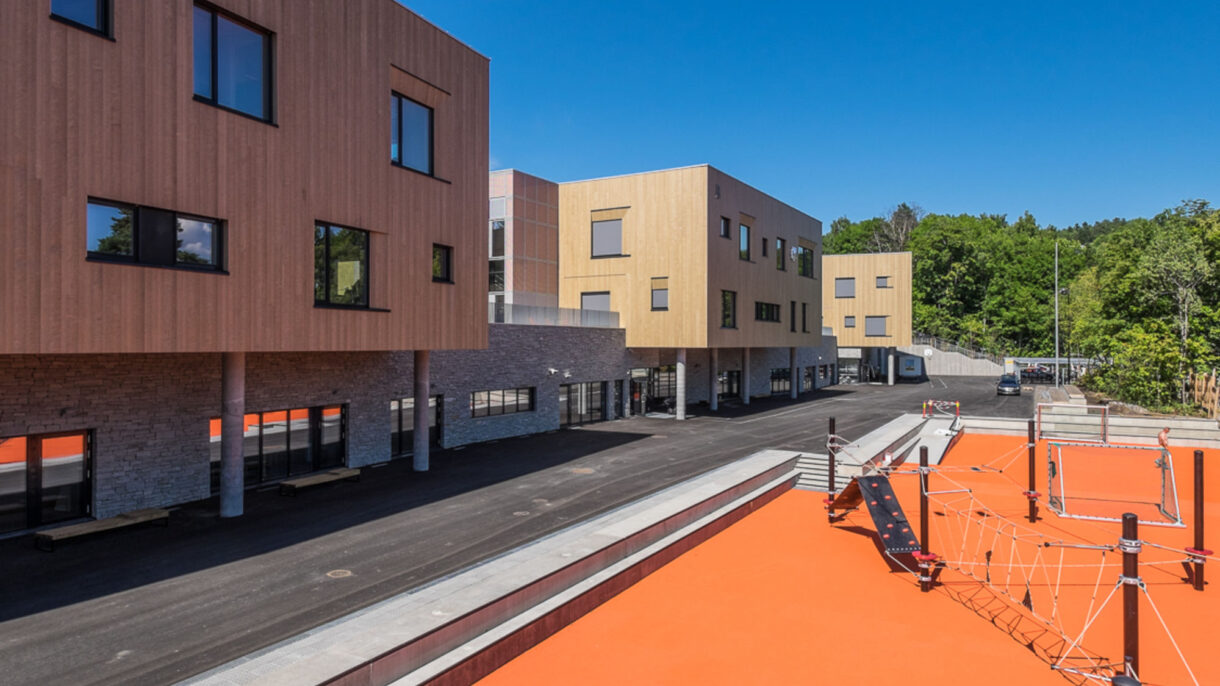
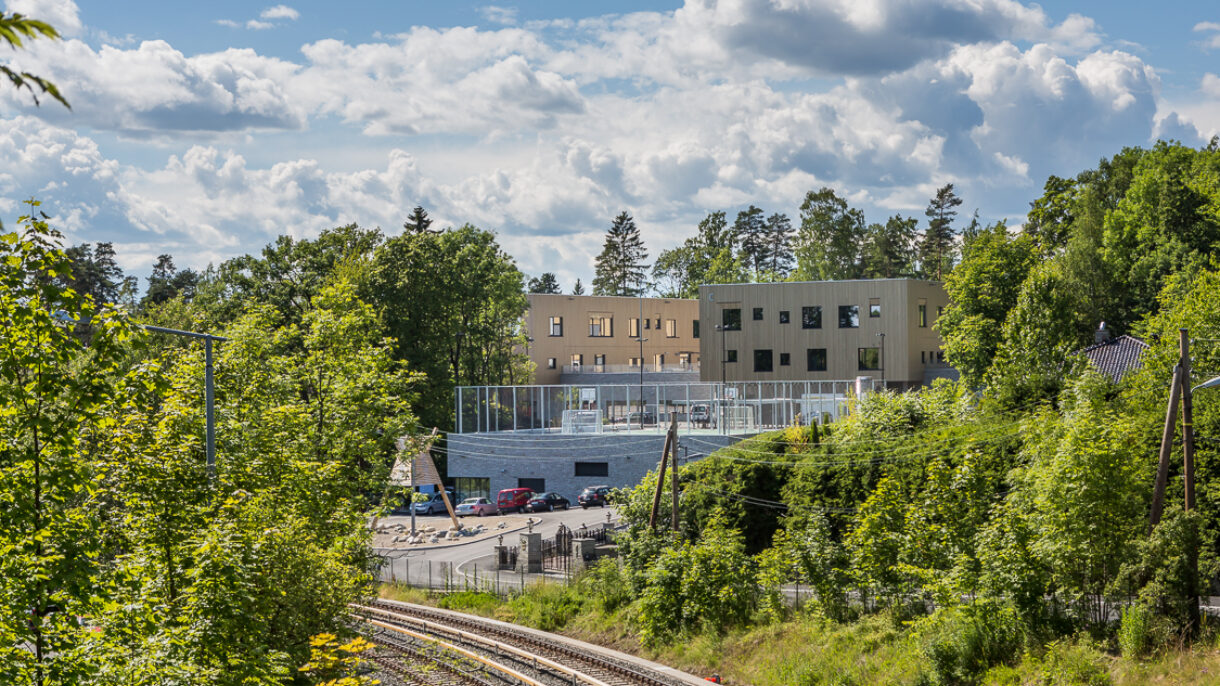
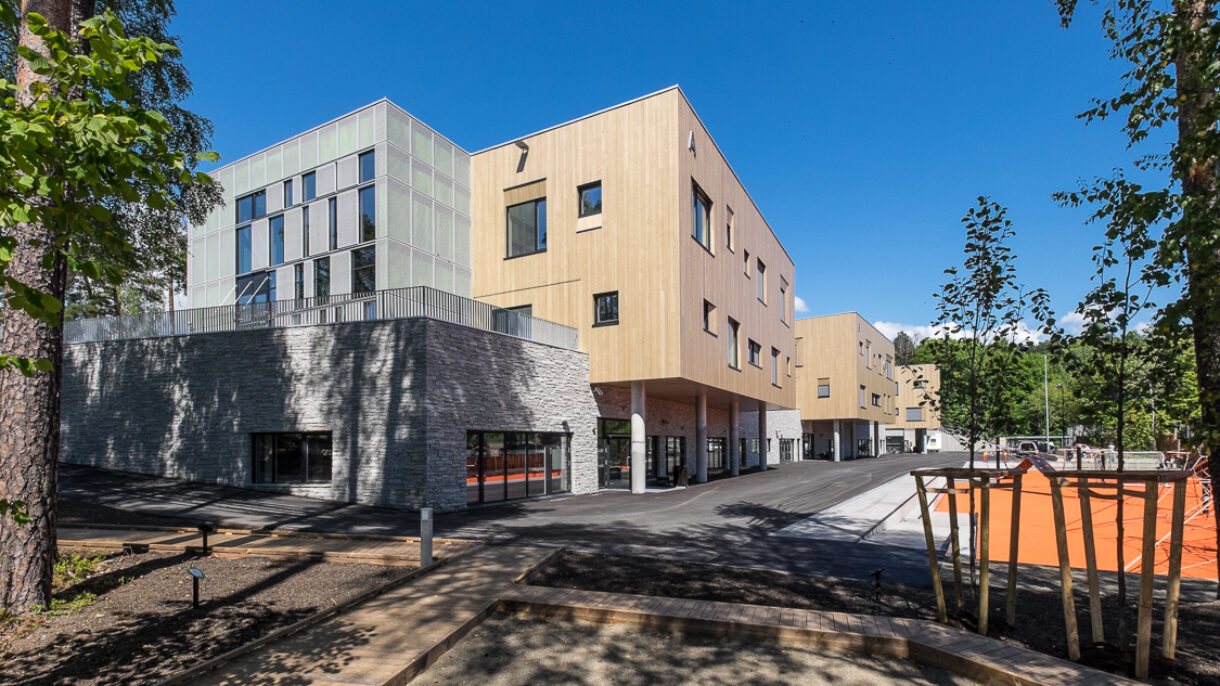
Bjørnsletta school lies on sloping terrain, oriented to the southeast. From the entrance in the east to the property´s highest point the height difference is 18 metres. The property benefits from good solar access, and borders a small forest with pine trees to the south. To the east, west and north are deciduous forest and private gardens. The school is organised so that the nature areas on the edges of the property can be retained. An old oak at the bottom of the slope, and as many of the surrounding trees as possible, were not to be touched in the construction process. The school building is in the style of neighbouring buildings, with the use of natural stone and wooden cladding as façade materials.
The ground floor of the school is set into the earth with three smaller building volumes above. A multi-purpose sports hall is situated beside the main entrance. The subdivided building form relates well to the green spaces and small houses of the area. The elementary, middle and upper-middle years each have one of the three volumes. These function as three smaller schools, each with its own identity and direct entrance to the ground floor. An internal hallway makes the wings easily accessible from the main entrance. The outside area between the wings is customised for each age group. Specially equipped spaces and an auditorium are located in the ground floor.
The amount of pupils requires an efficient use of space. Parts of the roof above the first floor are used as outdoor play areas for the children, and the roof over the auditorium is a playing field. The division into smaller volumes creates sight lines between the buildings as well as good sun and shade conditions. The roof of the inset auditorium is accessible from the school´s play area.
The building is designed to communicate the climate-friendly concept to the pupils. The pupils have access to information boards on the environmentally friendly materials used, and on the daily use of energy and water in the building. The use of alternative energy sources is a part of the school´s curriculum.
Low carbon strategies
A mobility plan was made in an earlier stage of the project. The school has a minimum of parking allocations.
The energy consumption of Bjørnsletta school meets passive house criteria. The building´s heating requirements are reduced because of good insulation and good windows, minimised cold bridges and high air-tightness values. The ventilation system has very efficient heat recovery units. The energy needs for ventilation are reduced through demand controlled and energy efficient fans (SFP-factor 1,5). The lighting system is also energy-efficient and demand controlled.
Bjørnsletta school and sports building will use a heat pump based on energy wells for space heating and DHW, and for cooling in the summer months.
During planning stage the project had a strong focus on climate-friendly materials that have been evaluated using EPDs. Robust and attractive materials were prioritised. The multi-purpose hall and ground floor consist of heavy materials, while the three blocks above have wood cladding, creating a lighter expression. The primary structure is concrete. Low-carbon cement was used in the concrete structure, in addition to a bubble deck system that reduces the quantity of concrete by 22 percent, compared to traditional floor slabs.
Key Figures
AREA COVERAGE
9677 m² (Gross area) for 790 students. (School: 8464 m², sports hall: 1213 m²). The school has a special unit for 12 autistic students which requires a lot of area).
| Area BTA | 9677 m2 |
| Number of residents/users | 790 |
| Glass share | 7,3 % |
| Compact clergy factor | 0,31 m3 volume/m2 |
GREENHOUSE GAS ACCOUNTING
| Reference | Project | Done | Operates | |
| Energy | 12,4 | 5,7 | 4,9 | — |
| Material Use | 13,8 | 11,4 | 7,1 | — |
| Transportation | 7,9 | 7,2 | 7,2 | — |
ENERGY
Net energy consumption: 64 kWh/m² year (Calculated according to NS3031 and standard climate) (average of school and sports hall)
| Net energy: | 64 kWh/m2/year (NS3031) |
| 58 kWh/m2/year Passive House standard | |
| Supplied energy is calculated: | 45 kWh/m2/year (NS3031) |
| 41 kWh/m2/year Passive House standard | |
| Energy sources: | Heat pump water-water (heating/ DHW), electric boiler (peak loads) |
ENERGY BUDGET
| Space heating: | 6,2 kWh/m2/year |
| Plumbing: | 8,8 kWh/m2/year |
| Hot water: | 16 kWh/m2/year |
| Fan operation: | 11,1 kWh/m2/year |
| Pump operation: | 0,9 kWh/m2/year |
| Lighting: | 13,7 kWh/m2/year |
| Technical equipment: | 10,7 kWh/m2/year |
| Other energy items: | 8,1 kWh/m2/year |
BUILDING TECHNICAL
| U-value roof: | 0,065 average value |
| U-value floor: | 0,1 average value |
| U-value exterior wall: | 0,1 average value |
| U-value window/doors: | 0,8 average value |
| Tightness Testing (measured) | 0,3 (At 50 Pa pressure) |
| SFP factor ventilation: | 1,5 kW/(m3/s) |
| Varmegjenvinneer ventilation: | 83 % |
TRANSPORTATION
| Distance to center: | 1800 m |
| Nearest welding mac. koll.knutepkt: | 100 m |
| Parking: | 1,65 (Pr. 1000 m2) |
| 0,16 (Pr. Unit/arb.plass) | |
| Bicycle Parking: | 28,83 (Per 1000 m2) |
| 0,28 (Pr. Unit/arb.plass) |
Project Information
PROJECT DETAILS
| Address: | Åsjordet 3, 0381 Oslo |
| Municipality: | Oslo |
| Project period: | 2010 - 2014 |
| Status: | Completed (2014) |
| Project type: | New building/addition |
| Function / building type: | School/educational facility, sports facility/building |
| Environmental standard: | Passive house standard |
| Exemplar program: | FutureBuilt |
| Competition form: | Framework agreement |
| Contract practice: | Design and build contract |
PROJECT TEAM
| Client: | Undervisningsbygg Oslo KF |
| Architect: | L2 Arkitekter AS | Østengen og Bergo Landskapsarkitekter AS |
| Project management (PM) | Undervisningsbygg Oslo KF |
| Environmental consultant: | Undervisningsbygg Oslo KF |
| Special adviser energy: | Itec AS, Asplan Viak as - KanEnergi |
| Counselors: | Siv ing Haug og Blom-Bakke AS | ÅF - Consult AS | Boro RIE AS | Norconsult AS | Brekke & Strand Akustikk AS | Forprosjekt: Tekka AS (PGL), Stormorken og Hamre AS (RIB), Ingenia (RIV), ÅF Consult (RIE) |
| Main contractor: | Veidekke entreprenør AS |
| Construction management: | Asenso AS |
| Subcontractors: | SN Bygg (betongarbeider), Konnerud Rør (rørlegger), Energima (ventilasjon), Elektrikergruppen (elektro), Porsgrunn Brønnboring (brønnboring), Byggteknisk stål (stålarbeider), Ellingard Naturstein (natursteinfasade). |